Before the where and the what, there is one question: are you out of traffic
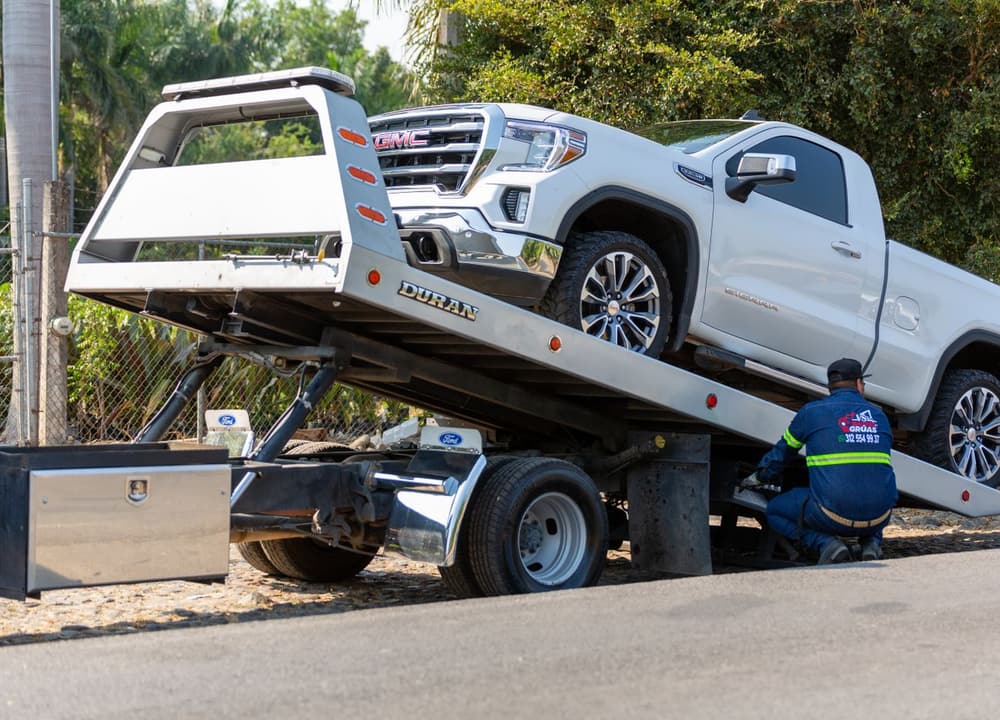
Towing calls come from the side of a road, usually in the dark, often from someone who has already been waiting. Everything a general purpose AI receptionist is good at, being polite and taking a booking, is the second half of that call. The first half is whether the caller is standing somewhere they can be hit.
From $99 a month · Robocalls are never billed
 Incoming callRosa Iglesias
“I'm on the hard shoulder of the interstate with the kids in the car.”
Safety instruction given · Location fixed · Truck dispatched
- Out of the lane
- The first question on every roadside call, before location or vehicle
- Vehicle and load
- Captured so the truck that goes is the truck that can lift it
- $0
- billed for robocalls and sales calls, on every plan
The call that separates a dispatch agent from a voice
Every AI receptionist on this results page books appointments and speaks well. This is the towing call where that stops being enough.
The caller says
“I've broken down and I think I'm on the highway somewhere near the junction.”
What a generic AI receptionist does
A generic AI receptionist starts working the problem it understands: name, number, vehicle, and an attempt to pin the location. Forty seconds of that is forty seconds of somebody standing in a live lane. It also books a standard truck without asking whether the vehicle is all wheel drive, low, or carrying a load, so the wrong truck arrives and the whole thing starts again.
What this one does
The first thing said is the safety instruction you configured: get behind the barrier, hazards on, stay out of the vehicle or in it depending on your rule. Then location, then the vehicle details that decide which truck. The order is fixed rather than chosen by a model reading the mood of the call.
AI receptionist for towing companies: what is actually configurable
Each of these is something the product does on a real call. Where it refuses to act, the refusal is the design rather than a limitation.
It fixes the location in a way a driver can use
Road, direction of travel, nearest junction or marker post, and any landmark in sight. Direction of travel is the field a general purpose agent never asks for and the one that costs your driver twenty minutes and a turnaround.
It matches the truck to the vehicle
Make and model, drivetrain, whether it rolls, whether the wheels turn, whether it is loaded, whether it is in a garage or underground car park with a height limit. A flatbed sent to a job that needed a wheel lift is a wasted run at your busiest hour.
It handles motor club and insurance work separately
A call that is coming through a club or a policy is a different job with a different rate and a different paper trail, and it asks. What it does not do is quote a cash price to somebody whose recovery is already covered.
It gives an honest ETA from your real position
Reading your live calendar and your configured coverage rather than saying twenty minutes because that is what people want to hear. The caller who is told forty and waits forty stays. The one who is told twenty and waits forty rings somebody else at minute twenty one.
What it asks on a towing call
Not a name and a preferred time. Each of these has an operational reason behind it, and every one of them is yours to change.
“Where exactly are you?”
The first question and the only one that matters if the call drops. Road name, junction, what they can see.
“Are you out of live traffic and somewhere safe?”
A caller standing on a shoulder changes this from a dispatch into an emergency-services call.
“What's the vehicle, and is it an automatic?”
Automatic, all-wheel-drive or seized wheels means a flatbed rather than a spec lift. Sending the wrong truck is a second callout.
“Is it in a parking lot — and what's the height clearance?”
The constraint nobody thinks to mention until the truck cannot get in.
“Where is it going?”
Destination decides the price and the route, and whether the job is worth taking at all at that hour.
“Is anyone injured, or is there an accident involved?”
An RTC is a police and ambulance matter first, and a recovery second.
What it will never do on a towing call
You are handing your phone to software that talks to your customers when you cannot. These are the lines it does not cross, and the exact words it uses instead.
A live lane is a 911 call, not a booking
A caller stopped on a highway, in a live lane or on a shoulder is told to get out of the vehicle, behind the barrier, and to ring emergency services. The agent does not spend forty seconds gathering vehicle details while somebody stands next to moving traffic.
What it actually says
“Get out of the car on the passenger side and get behind the barrier, then ring 911. I'm dispatching at the same time — but do that first.”
Injuries stop everything
If anyone is hurt, or the caller mentions a collision with another vehicle, the agent redirects to emergency services and escalates to a human immediately. Recovery is a later problem.
What it actually says
“Is anyone hurt? Then please ring 911 now — they need to be there before we are. I'm getting a person on the phone with you.”
It won't quote a tow it hasn't seen
It gives your hook fee and your per-mile rate, because those are fixed. It does not price a winch-out, an underground recovery or an accident tow from a description — those depend on access, and a number invented on the phone is one your driver has to renegotiate at the roadside.
What it actually says
“The hook's $95 plus $4 a mile. If it needs winching out I can't put a number on that until the driver sees it.”
The four things it answers from
Configuration rather than something a model has been asked to remember. Change one at eight in the evening and the next call uses the new value.
Hook fee
$95
Per mile
$4
Coverage
40 miles
Fleet
2 flatbed, 1 spec lift
What towing companies say before they say yes
In the words they are usually put in. Where the objection is right, it says so.
“Roadside calls are too chaotic for software.”
They are chaotic, which is an argument for a fixed order of questions rather than against one. The agent asks the same five things in the same sequence at 3am on a wet Tuesday as it does at noon, which is more than can be said for anybody answering their fourth call in ten minutes.
“The ETA is the whole conversation and I can't automate it.”
The ETA comes from your calendar and your coverage rules, not from the model's imagination. Where it does not have enough to say a number, it says so and commits to a callback window instead of inventing one.
“I dispatch by radio, not by calendar.”
Then the calendar is the record and the radio is still the radio. What changes is that the call was answered on the second ring with the location, the direction of travel and the vehicle already written down before you keyed the mic.
It books into the calendar you already keep
Google, Outlook, Apple, Exchange, CalDAV. An AI receptionist that emails you a summary has built a nicer voicemail; this one creates the appointment and texts the caller.


































…and a lot more besides
- Warm transfersWarm transfersAnnounced — who is calling and why, before you take the line.
- Spam never billedSpam never billedRobocalls are spotted, zero-rated, and never become a customer.
- A number per sourceA number per sourceVan, yard sign, Google listing — see which line brings the work.
- Team & on-callTeam & on-callTries you, then a second number, then whoever is on call.
- Run it by textRun it by textReply to a text to move a job, block a morning, clear a day.
- Clear a day, everyone toldClear a day, everyone toldCall off a wet Tuesday; every customer is told and re-offered.
- Never invents an answerNever invents an answerNo price or slot it was not given. It takes a message instead.
- Any trade, no codeAny trade, no codeGoal, questions and guardrails are settings, not a rebuild.
What does it ask before anything else?
Whether the caller is out of the live lane and safe. That instruction is configured by you and delivered before location, vehicle or payment, because the rest of the call is worthless if the answer is no.
Will the right truck be sent?
It captures drivetrain, whether the vehicle rolls, whether the wheels turn, load, and any height restriction where the vehicle is. Those are what decide flatbed against wheel lift.
Can it give an ETA?
From your live calendar and coverage settings. Where it cannot, it says so and commits to a specific callback rather than guessing.
Does it handle motor club jobs?
It establishes whether the recovery is covered and by whom, and routes those differently from cash work so nobody gets quoted for something already paid for.
What does it cost?
From $99 a month, flat, with unlimited call flows and a monthly talk time allowance. Robocalls are never billed, and there is a free tier for testing first.
Comparing against a human answering service instead?
That is a different question with a different answer, and it has its own page: the towing answering service, with a full towing call played second by second.
Trades that answer the phone the same way
The same archetype, which is what the product actually branches on. Every trade has one of these pages.