The inquiry that reaches voicemail instructs another firm
Vandial answers every call, takes a structured intake — matter type, the other side's name for your conflict check, the dates that matter — and books the consultation. It does not give legal advice, comment on the merits, or quote a fee it was not given.



Answering service for lawyers — intake, never advice


One law firm call, and what it left behind
- Three firms
- in one afternoon. The instruction goes to whichever one picked up
- Structured
- matter type, counterparty, deadlines and source, on every call
- No advice
- no merits, no valuation, no “you probably have a case”
Answered on the second ring. Every field below was captured during the call — nobody typed it in afterwards.
“Our offer's been accepted and we need a attorney this week.”
Classified0:18
- new matter
- residential closing
- sale + purchase
Captured0:41
- 2 addresses
- counterparty agent
- conflict check queued
Booked1:14
- Wed 10am
- conflict check pending
Booked — consultation Wed 10am, conflict check queued
Read the whole law firm call, line by line
- 0:02Bernard Whitaker: Our offer's been accepted and we need a attorney this week.
- 0:05Vandial: Congratulations — that's a residential closing. I can get you in with someone. Is it a purchase, a sale, or both?
- 0:16Bernard Whitaker: Both. We're selling ours and buying the new one.
- 0:18Classified — new matter · residential closing · sale + purchase
- 0:26Vandial: Can I take the addresses and the name of the other side's agent? We run a conflict check before the appointment.
- 0:41Captured — 2 addresses · counterparty agent · conflict check queued
- 0:50Vandial: Is there a deadline you're working to — an exchange date, or anything in the chain?
- 0:59Bernard Whitaker: They want to exchange within six weeks.
- 1:08Vandial: Wednesday at ten with Ms Adeyemi. She'll go through fees and timelines properly then.
- 1:14Booked — Wed 10am · conflict check pending
Answered, understood, booked
One number, picked up on the second ring — at 2am, on a Sunday, while you're already working. By the time the caller hangs up, it is in your calendar.
Get in touchSee the call recordIt answers
Answered on the second ring, at any hour, including the evening calls — which in this trade are the ones that instruct somebody by morning.
- 0:00Incoming call
- 0:02Answered by Vandial2 rings
- 0:05“Hello, Marlow Plumbing.”
It understands
A structured intake: matter type, the other side, the deadlines, and how they found you. Taken properly, and never straying into advice.
- Job
- Water heater — leaking
- Where
- 14 Marlow Street
- Access
- Side gate, dog in yard
- Urgency
- Today if possible
- Still on
It books
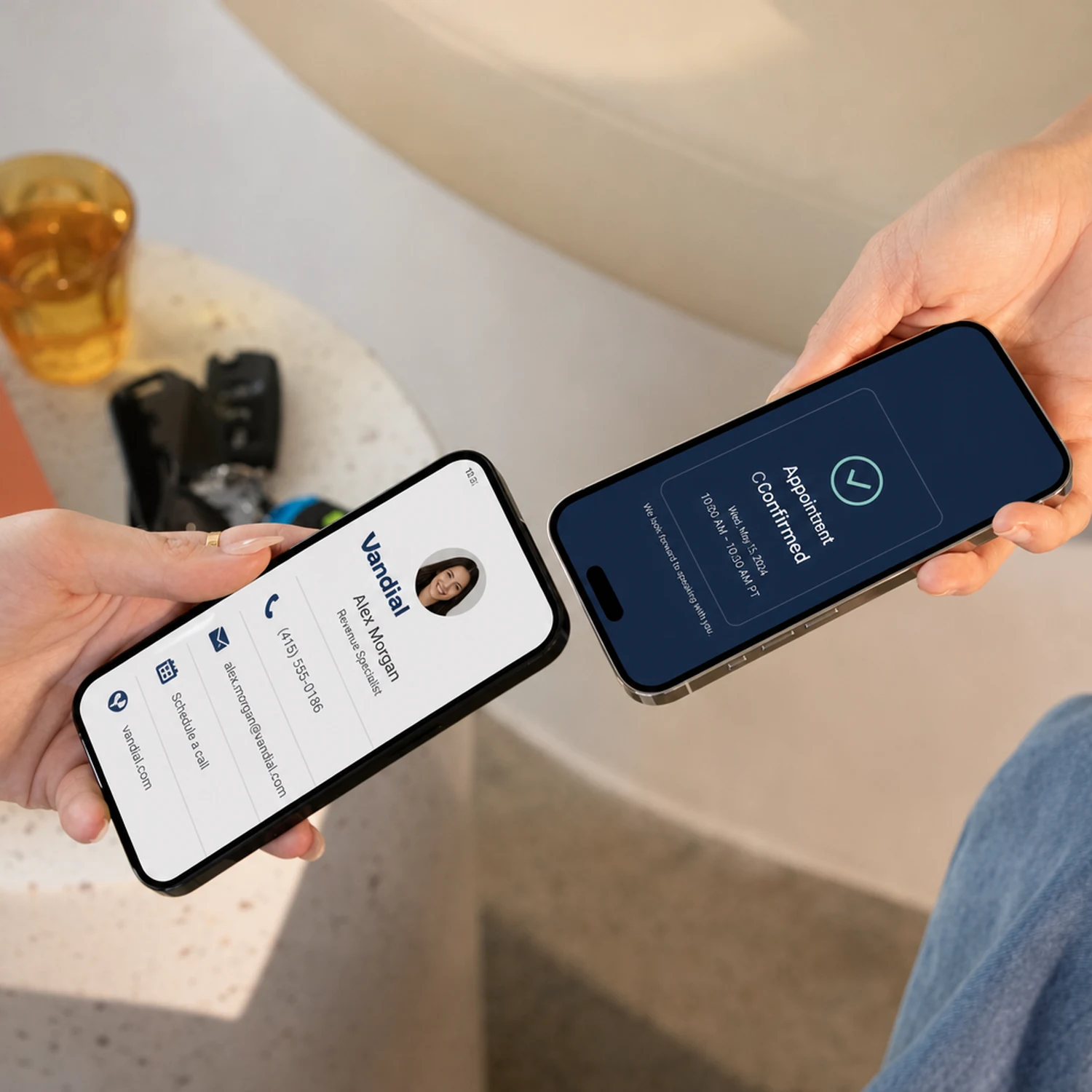
The consultation booked with the right attorney, the conflict check queued, and a confirmation sent with what to bring.
Text to Dave · 13:01
You’re booked for today, 1–2pm. Reply R to move it.
It asks what you would ask
These are the questions the agent runs for law firms, and the operational reason each one exists. Change them, add your own, or take them out — they are configuration, not code.
What kind of matter is it?
Routes to the right department and the right attorney. A closing call in a litigator's calendar is a wasted hour for both.
Who is the other side?
The conflict check cannot start without it, and starting it before the consultation is what stops a firm discovering a conflict after taking instructions.
Is there a deadline or a limitation date?
A limitation date changes everything about urgency, and it is the one thing a caller assumes the firm already knows.
Have you instructed anyone else on this?
A caller shopping between firms, or moving from one, is a different conversation — and sometimes a file transfer.
How did you hear about us?
The only marketing attribution most firms will ever get, captured on every call rather than never.
Are you the client, or calling on someone's behalf?
Decides who can be spoken to, and it is a question that gets awkward if it is asked late.
More than a answering service for lawyers
An answering service takes a message and charges you for it. Vandial knows your prices, your patch and your diary — so it books the job, or puts a real emergency straight through to you.
Get in touchSee what it costsIt picks up out of hours, and while your line is busy
By the time a legal inquiry rings, it has already cost you more in marketing than any other call the firm takes — and it goes to whichever firm picks up. A voicemail box is the most expensive thing in the building.
It knows your prices, your patch and your hours
The intake is structured and the same every time, so what reaches the attorney is a matter, not a message. Matter type, counterparty, deadlines, and how they found you, captured on every call including the ones at 9pm.
What it knows
Fixed-fee consultation
$250
Residential closing
From $1,400
Departments
Property, family, wills
Conflict check
Before every consultation
What matters reaches you. The rest waits
It does not give advice, comment on merits, or quote fees it was not given. That is not a limitation to work around in this trade; it is the condition on which an answering service can be used at all.
Your rule: if they say gas, flood or no heat — ring Sam, then me.
Every call written up, tagged and searchable
Conflict details are captured up front and the check is queued before the consultation, so a conflict surfaces at the right end of the process rather than the wrong one.
Dave Whitfield · Sunday, 4m 12s
Water heater, leaking
Leaking from the base. Booked for Tuesday 1–2pm. Side gate open, dog in the yard. Asked whether the service call fee applies — told $99, waived on repair.
What it will never do
You are handing your phone to something that talks to your customers when you are not there. These are the lines it does not cross in law firm, and the words it uses instead.
It gives no legal advice. None
It will not say whether someone has a case, what they are likely to receive, what the law says, or what they should do next. The distinction between taking an intake and giving advice is the entire reason a firm can use this at all, and it is enforced rather than encouraged.
What it actually says
“I'm not able to advise on that — I'm not a lawyer. What I can do is make sure Ms Adeyemi has the full picture before you speak on Wednesday.”
It never comments on the merits or the value
No indication of whether a claim is strong, what it might be worth, or how long it will take. Those are the sentences a caller repeats back later, and a firm should not be defending a number an answering service invented.
What it actually says
“I honestly couldn't tell you what it's worth, and you shouldn't rely on me if I did. That's exactly what the consultation is for.”
Conflict details are captured before the appointment
The other side's name is taken on the intake call and the check is queued, so a conflict surfaces before a consultation rather than after instructions have been taken. That sequencing is a professional obligation, not a convenience.
What it actually says
“Can I take the other party's name? We run a conflict check before every consultation — it's just so we're sure we can act.”
The job lands where you already work
Google, Outlook, Apple, Exchange, CalDAV — whichever calendar you already keep. Then your payments, your CRM, and whatever you automate with.
Get in touchSee what it costs…and a lot more besides
- Warm transfersWarm transfersAnnounced — who is calling and why, before you take the line.
- Spam never billedSpam never billedRobocalls are spotted, zero-rated, and never become a customer.
- A number per sourceA number per sourceVan, yard sign, Google listing — see which line brings the work.
- Team & on-callTeam & on-callTries you, then a second number, then whoever is on call.
- Run it by textRun it by textReply to a text to move a job, block a morning, clear a day.
- Clear a day, everyone toldClear a day, everyone toldCall off a wet Tuesday; every customer is told and re-offered.
- Never invents an answerNever invents an answerNo price or slot it was not given. It takes a message instead.
- Any trade, no codeAny trade, no codeGoal, questions and guardrails are settings, not a rebuild.
What law firms say before they say yes
Three objections, in the words they are usually put in. Where the objection is right, it says so.
“An inquiry is worth hundreds. I'm not risking it on software.”
That is the argument for answering it, not for letting it ring out. The inquiry you paid to generate goes to whichever firm picks up, so the risk you are actually carrying is the voicemail box — and it is the most expensive thing in the building.
“It cannot give legal advice. Full stop.”
Full stop, and it is enforced rather than hoped for. It does not say whether someone has a case, what the law says, what a matter might be worth, or what to do next. It takes a structured intake and books a consultation — that distinction is the whole condition on which a regulated firm can use this at all.
“Conflicts have to be checked before we take instructions.”
Which is why the other side's name is captured on the intake call and the check queued before the consultation — at the only moment the caller is actually available to give it, rather than after somebody has already taken instructions.
Already decided you want AI to answer it?
Then the question is which one, and that is a different page: what a generic AI receptionist gets wrong on a law firm call, and what is configurable about this one.
AI receptionist, law firmsNot your trade?
The agent's questions, urgency rules, escalations and vocabulary are all configuration. Nothing about a trade is hard-coded, which is why there are 31 of these and not one.
HVACPlumbingElectricalRoofingGarage doorPest controlLandscapingCleaningFuel deliveryAuto repairDealership serviceTowingAppliance repairLocksmithMovingRemodelingDentalMedical practiceChiropracticVeterinarySalon & spaReal estateProperty managementFuneral homesInsurance agenciesRestaurantsAccountingTherapy practicesHome health careHotelsTools for the next step in your business
Qualify the inquiry
Capture the service, service details and timing. Use your booking rules to decide the next step and when a person should help.
Keep the booking moving
Offer times from your connected calendar, handle rescheduling and send confirmation so interested clients leave with a clear next step.
Welcome the next visit
Follow up with past inquiries and returning clients. Keep the context from the previous conversation and make the next visit easier to arrange.
Explore the questions behind better bookings







Discover what Vandial can do for you
See how an AI agent can help your business qualify inquiries and book the next step.
FAQ
Will it give legal advice?
No, and this is enforced rather than hoped for. It does not say whether someone has a case, what the law says, what they should do, or what a matter might be worth. It takes an intake and books a consultation — the distinction between those two things is what makes this usable in a regulated profession.
How does it handle conflict checks?
It captures the other side's name and the matter details on the intake call and queues the check, so a conflict surfaces before the consultation rather than after instructions have been taken. It cannot run your check for you, but it collects what the check needs at the only moment the caller is available to give it.
Can it quote fees?
It states fixed fees you have given it — a closing quote from your own scale, a fixed-fee consultation — and nothing else. It will not estimate the cost of a contested matter, because nobody sensibly can and a caller will hold the firm to the number.
Does it route to the right department?
Yes. Matter type is the first thing established, and it books with the attorney who handles it. A closing inquiry booked into a litigator's calendar wastes an hour of a senior person's time and starts the relationship badly.
What about limitation dates and urgent matters?
It asks about deadlines directly, because callers assume you already know and mention them last. Anything with a date attached is flagged and can be escalated rather than booked for the following week.
What information does it record, and who can see it?
The intake fields you configure, the transcript and the recording, visible to the people in your firm you give access to. We make no compliance certification claims on this page — what we can state precisely is what it captures, what it refuses to discuss, and where it is held.
What does it cost?
Vandial’s paid plans start with Standard at $150 a month for 1,000 AI conversations, Pro at $350 for 2,000, and custom Enterprise plans. Contact us to discuss your workflow and setup; free trials and self-service testing are not available. Standard includes one AI channel, Pro three and Enterprise five. Additional AI conversations cost $0.40 each on paid plans. Voice minutes, phone numbers, paid messaging and implementation are quoted separately. See the pricing page for the conversation definition and plan details.
“An inquiry is worth hundreds. I'm not risking it on software.”
That is the argument for answering it, not for letting it ring out. The inquiry you paid to generate goes to whichever firm picks up, so the risk you are actually carrying is the voicemail box — and it is the most expensive thing in the building.
“It cannot give legal advice. Full stop.”
Full stop, and it is enforced rather than hoped for. It does not say whether someone has a case, what the law says, what a matter might be worth, or what to do next. It takes a structured intake and books a consultation — that distinction is the whole condition on which a regulated firm can use this at all.
“Conflicts have to be checked before we take instructions.”
Which is why the other side's name is captured on the intake call and the check queued before the consultation — at the only moment the caller is actually available to give it, rather than after somebody has already taken instructions.